Craft Sword 3D: Monster Hunt
- 4.9
- Rating
- 1.00M
- Installs
- Free
- Price
 Analysis by App-foxy
Craft Sword 3D: Monster Hunt is an action game built around one clear idea: making a better sword and then putting it to work against monsters. I found that the crafting loop is more important than the title might first suggest. It is not simply a quick combat game with a decorative upgrade screen; the act of improving equipment gives each short play session a practical purpose. I could enter a hunt with a small goal in mind, collect progress through play, and return to the weapon-building side with a reason to continue.
The game is developed by Volodymyr Pukha and is free to start, which makes it easy to try without committing money upfront. Its Everyone age rating also makes the presentation approachable for younger players and families, although the repeated action loop will appeal most to people who enjoy simple progression rather than a long, story-heavy adventure. With a 4.9 average from around 20 thousand ratings and more than a million installs, it has clearly found an audience among players who like compact mobile action games.
Why the sword-crafting loop matters
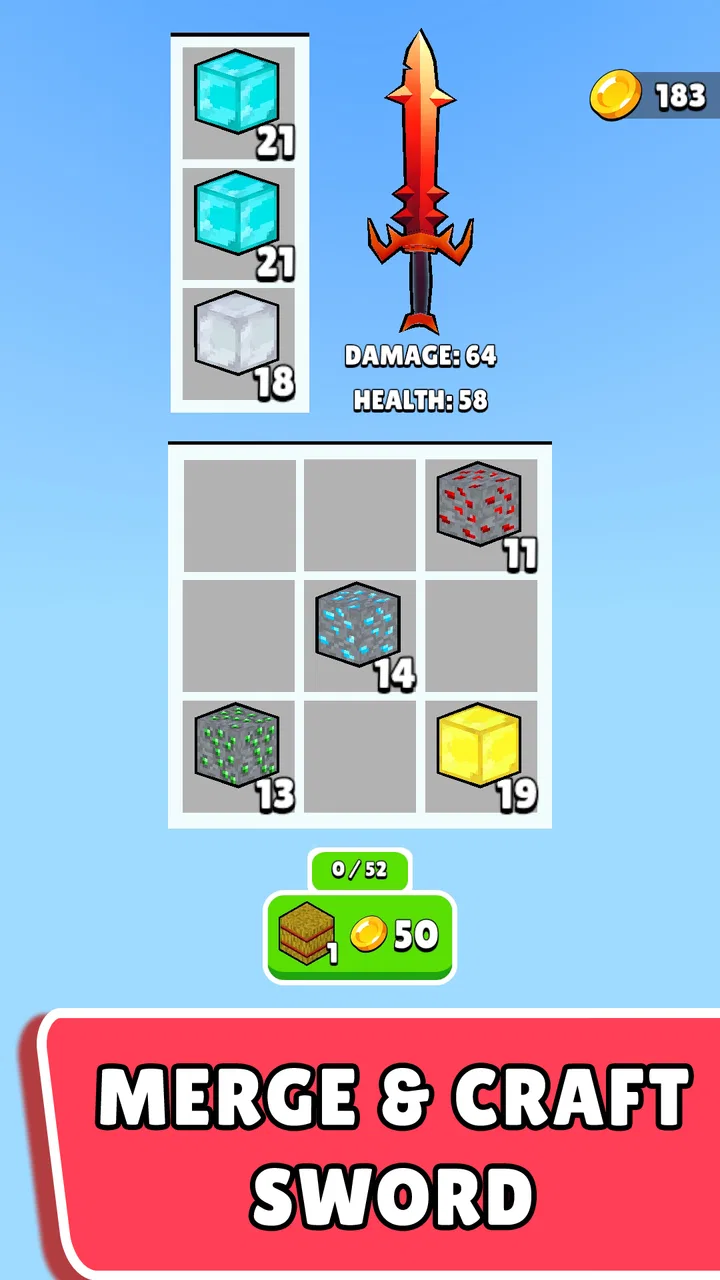
The strongest capability here is the connection between crafting and hunting. In many mobile action games, upgrades feel like a menu obligation: tap a button, watch a number rise, and return to the same fight. Craft Sword 3D: Monster Hunt makes the weapon itself the visible focus, so improvement feels more connected to what I am doing. The sword is not just an abstract statistic; it is the object I am trying to build before the next round of monster hunting.
You May Also Like

 Blood Strike: 2.5 Anniversary
Blood Strike’s Loadouts Turn Every Drop Into a Tactical Gamble
A close look at Blood Strike’s custom loadouts: how fast access to signature weapons reshapes its battle royale rhythm, rewards preparation, and narrows the gap between fights.

 Pandora - Music & Podcasts
Pandora’s Music Is Easy to Start, but Harder to Recover
Pandora’s strength is its low-effort path from a seed to a station. Its weak spot is how much confidence it asks you to place in connection, setup, and quiet recovery.

 8 Ball Pool
 Is Built on Rivalries, Rematches, and Routine
A close look at the rivalries, rematches, shared routines, and unanswered safety questions that turn a quick pool match into a persistent mobile community.

 Samsung Music
’s Quiet Strength Is Playing What You Already Own
Its reach comes less from spectacle than from dependable access to a personal library. That simplicity is both the app’s strongest retention engine and its ceiling.

 AccuWeather: Weather Radar
AccuWeather Review: A Quick, Clear Forecast for Everyday Decisions
For everyday plans, the best forecast is the one you can understand quickly. AccuWeather makes rain timing, radar, and local conditions easy to act on, with a few trade-offs.

 Hill Climb Racing
Why Hill Climb Racing Still Turns Crashes Into One More Run
A tiny car, a bumpy hill and one more upgrade: Hill Climb Racing keeps resurfacing because its simple chaos makes every near-miss feel personal.
More From Our News Desk
View All News


That connection changes the rhythm. Instead of playing only to clear another encounter, I can play with a specific purpose: gather what is needed for the next improvement, test the result, and decide whether another upgrade is worth pursuing. This is a modest design choice, but it gives the action a useful sense of direction. When I have only a few minutes, I can still make progress toward a concrete objective rather than feeling that I have stopped halfway through a larger mission.
The crafting emphasis also helps the game stand apart from a conventional endless-action alternative. A pure arcade fighter is usually about immediate reactions and score chasing. A traditional role-playing game may bury equipment management under many menus and layers of statistics. This game sits between those approaches. It keeps the central idea easy to understand while giving the player a reason to think about the next hunt.
The important practical effect is that every improvement is judged by what it enables in the next fight. That makes the loop satisfying when the upgrade feels earned, but it also exposes the game’s limitation: players who want deep character builds, elaborate equipment combinations, or a large narrative world may find the system intentionally light.
How I approached the first sessions
I would recommend beginning with a simple goal rather than trying to optimize everything immediately. The temptation in a crafting game is to spend every available resource as soon as a button becomes available. A better habit is to notice what the next hunt seems to demand, then improve the sword with that upcoming challenge in mind. This keeps the upgrade process tied to play instead of turning it into a routine of tapping through menus.
That approach is especially useful on a phone, where attention is often divided. If I am playing while waiting for an appointment or taking a short break, I do not want to reconstruct a complicated build from memory. The game’s central loop is easier to resume because the sword provides a clear visual and practical anchor. I can remember where I was: hunting, collecting progress, or preparing the next weapon improvement.
Another useful habit is to treat failed or less successful hunts as information rather than wasted time. If an encounter feels difficult, immediately repeating it without changing anything can make the game feel repetitive. I prefer to use that moment to reconsider the sword’s current development, then return once the next meaningful improvement is available. This creates a small decision point in a game that could otherwise become a simple sequence of attacks.
What the action feels like in practice
The action is designed to support the crafting loop rather than overwhelm it. I never felt that I needed to learn a large collection of controls before understanding the basic appeal. That makes the game approachable for someone who wants a straightforward monster-hunting experience, but it also means experienced action players should not expect the precision or variety of a full console-style combat system.
The best way to play is to keep the sessions focused. I would not approach it expecting a long evening of uninterrupted exploration. Its appeal is closer to a repeatable mobile routine: hunt, improve, and test the result. That structure works well when I want a game with a visible sense of progress, but it can feel narrow if I am looking for changing environments, complex objectives, or a story that constantly introduces new ideas.
The current version is 0.8.210, and the game supports devices running Android 7.1 or later. For an older compatible phone, the relatively direct design may be more comfortable than a visually crowded action game, although the experience will still depend on the device and its general performance. I would check compatibility before installing on an especially old handset, not because the game is difficult to understand, but because smooth action matters when the entire appeal depends on repeating hunts comfortably.
The everyday scenario where it works best
The clearest use case for me is a short break during a busy day. Imagine having ten minutes before a train arrives or between tasks at work. A large role-playing game may ask for too much concentration, while a competitive action game can make a brief session feel stressful. Here, I can open the game, complete a hunt, review the sword’s progress, and stop with a clear sense that the session had a purpose.
The crafting loop is also useful for players who enjoy small goals more than high scores. I like having something to work toward even when I am not in the mood for a demanding challenge. The sword gives that goal a physical identity, and the monster hunts provide the reason to keep improving it. This is more motivating than a generic experience bar for players who prefer to see progress represented by an object they are actively building.
Parents looking for a free action game suitable for a broad age range may also find the Everyone rating reassuring. I would still recommend that adults look at the device’s purchase settings before handing the phone to a child, because in-app purchases are available at $3.49 per item. The game can be started without paying, but the presence of optional purchases is worth remembering in a shared-device household.
Where the loop starts to show its limits
The same focus that makes the game easy to pick up can make it feel repetitive over longer sessions. Crafting and hunting are a strong pair, but they do not automatically provide the variety of a game with multiple character classes, elaborate maps, or a large campaign. If I play continuously for too long, the pattern becomes more noticeable: prepare the sword, hunt monsters, improve the sword, and repeat.
That is not necessarily a flaw. It is a question of fit. Players who enjoy incremental progress and repeated attempts may appreciate the consistency. Players who need constant novelty may prefer a larger action role-playing game or a level-based adventure with more changing objectives. I would choose this one for a compact, focused loop rather than for exploration or storytelling.
The free entry point is convenient, but the available purchases can affect how each player thinks about progress. I prefer to treat the paid items as optional and judge the game by the satisfaction of earning improvements through play. Anyone who dislikes seeing purchase options in a free game should keep that trade-off in mind. The game is most enjoyable when the sword’s development feels like the result of my hunting decisions, not simply something to accelerate with a payment.
There is also a difference between accessible controls and deep combat. A newcomer can understand the basic objective quickly, but a veteran looking for frame-perfect timing, extensive move sets, or competitive mastery may find less to study. Compared with a traditional fighting game, the emphasis here is on the broader progression loop. Compared with a complex role-playing game, it is more immediately readable but less layered.
Small decisions that improve the experience
My first tip is to avoid spending resources automatically. Before crafting, I would ask whether the improvement helps with the next hunt or merely satisfies the urge to upgrade. That pause makes the game feel more strategic without adding unnecessary complexity. It also reduces the chance of reaching a difficult encounter and realizing that the most useful improvement was spent earlier on a less urgent choice.
My second tip is to use the sword as a session marker. At the beginning of a break, decide whether the goal is to collect progress, complete a hunt, or prepare an upgrade. This turns an open-ended mobile game into a short personal challenge. It is a small workflow, but it prevents the repetition from becoming aimless.
My third tip is to stop after a meaningful milestone instead of forcing one more round. Because the loop is easy to repeat, it can be tempting to continue even when attention is fading. Ending after a successful hunt or a useful sword improvement leaves the next session with a clear starting point. That is particularly helpful for casual players who want steady progress without turning the game into a time-consuming habit.
Finally, I would keep expectations realistic about the role of the crafting system. It adds purpose to the action, but it should not be mistaken for a full equipment simulator. The pleasure comes from the relationship between a visible weapon and the next monster hunt, not from managing a huge collection of statistics. Understanding that early makes the game more enjoyable.
Who will get the most from it
I think Craft Sword 3D: Monster Hunt is best for someone who wants a free action game that can be understood quickly and revisited often. It suits players who enjoy building toward a stronger weapon, repeating hunts to make progress, and seeing a direct connection between preparation and combat. It is also a sensible choice for casual mobile players who prefer a focused objective over a large world with many competing systems.
It may be a good first step for someone who has not played many action games. The central question is easy to grasp: can I improve my sword enough to handle the next monster hunt? That simplicity lowers the entry barrier, and the Everyone age rating makes the game broadly approachable. The developer, Volodymyr Pukha, has kept the premise clear enough that I did not need a long explanation before understanding what I was supposed to do.
I would steer a different player elsewhere if their priority is a rich story, cooperative play, deep character customization, or a combat system that rewards advanced technical mastery. A larger action role-playing game would offer more variety, while a dedicated arcade fighter would deliver more immediate mechanical intensity. This game’s strength is the middle ground between those choices: a compact loop with crafting at its center.
The rating of 4.9 from around 20 thousand ratings and the install count of over a million suggest that the straightforward formula has connected with many players. I would not use popularity alone as a reason to install it, but those figures match my impression that the game is easy to approach and easy to return to. Its audience is likely to value convenience and visible progress more than a huge amount of content.
My recommendation after testing the concept
I recommend giving Craft Sword 3D: Monster Hunt a try if the idea of making a sword, taking it into battle, and improving it for the next challenge sounds more appealing than managing a sprawling adventure. The free price makes experimentation simple, and the age rating keeps the presentation broadly accessible. Just remember that optional purchases cost $3.49 per item, so I would review purchase controls before sharing the device with a child.
For me, the game succeeds because crafting is not isolated from the action. It gives the hunts a reason, and the hunts give the crafting meaning. That relationship is the feature worth focusing on: it turns short sessions into a recognizable routine and gives casual progress a little more personality than a standard upgrade menu.
My final view is positive, with one clear condition: choose it for its focused sword-building loop, not because you expect a massive action adventure. If that compact structure fits the way you play on mobile, it can be an enjoyable free download. If you need constant variety or sophisticated combat, the usual larger alternatives will serve you better.
FAQs for Craft Sword 3D: Monster Hunt
01What is Craft Sword 3D: Monster Hunt about?
Craft Sword 3D: Monster Hunt is an immersive adventure game that combines crafting, exploration, and monster hunting. Players can build their own weapons and tools to battle a variety of monsters. The game features a rich, blocky 3D world where strategy and creativity are key to survival and success.
02Is Craft Sword 3D: Monster Hunt free to play?
Yes, Craft Sword 3D: Monster Hunt is free to download and play. However, the game includes optional in-app purchases that can enhance gameplay, such as special tools, weapons, and skins. These purchases can provide advantages or customization options for players who wish to personalize their experience.
03What are the system requirements for Craft Sword 3D: Monster Hunt?
Craft Sword 3D: Monster Hunt is available on both Android and iOS platforms. For Android users, a minimum version of Android 5.0 is recommended, while iOS users should have at least iOS 10.0. A stable internet connection is also required for certain features and updates within the game.
04Are there multiplayer options in Craft Sword 3D: Monster Hunt?
Yes, Craft Sword 3D: Monster Hunt offers multiplayer modes where players can team up with friends or other players online. This cooperative gameplay allows for strategic collaboration in crafting and hunting monsters, providing a more engaging and social experience within the game’s expansive world.
05How does Craft Sword 3D: Monster Hunt handle user data and privacy?
Craft Sword 3D: Monster Hunt takes user privacy seriously. The game requires access to certain device permissions for optimal performance but adheres to strict data privacy policies. Users can review these policies within the app to understand how their data is collected, used, and protected.
Pros
- Engaging 3D graphics enhance gameplay.
- Simple controls suitable for all ages.
- Variety of monsters keeps it exciting.
- Crafting system adds strategic depth.
- Frequent updates improve content.
Cons
- In-app purchases can become costly.
- Advertisements interrupt gameplay.
- Requires internet for full features.
- Limited storyline depth.
- Some levels feel repetitive.

Craft Sword 3D: Monster Hunt
Gallery